AI-Ready CRM Data: What It Means When Agents Are the Readers
AI-ready CRM data is revenue data that a software agent can read and act on without a person double-checking it first. Every record is unique, the fields agents depend on are filled, each record carries a clear label, and conflicts such as mismatched owners or broken associations are flagged before an agent acts.
For most of CRM history, the reader was a person, usually a rep or a sales manager on a sales-led team. A sales rep could look at two "Acme" company records and guess which one was real. An agent can't make that guess reliably. When agents become the readers, the bar for "good enough" data changes.
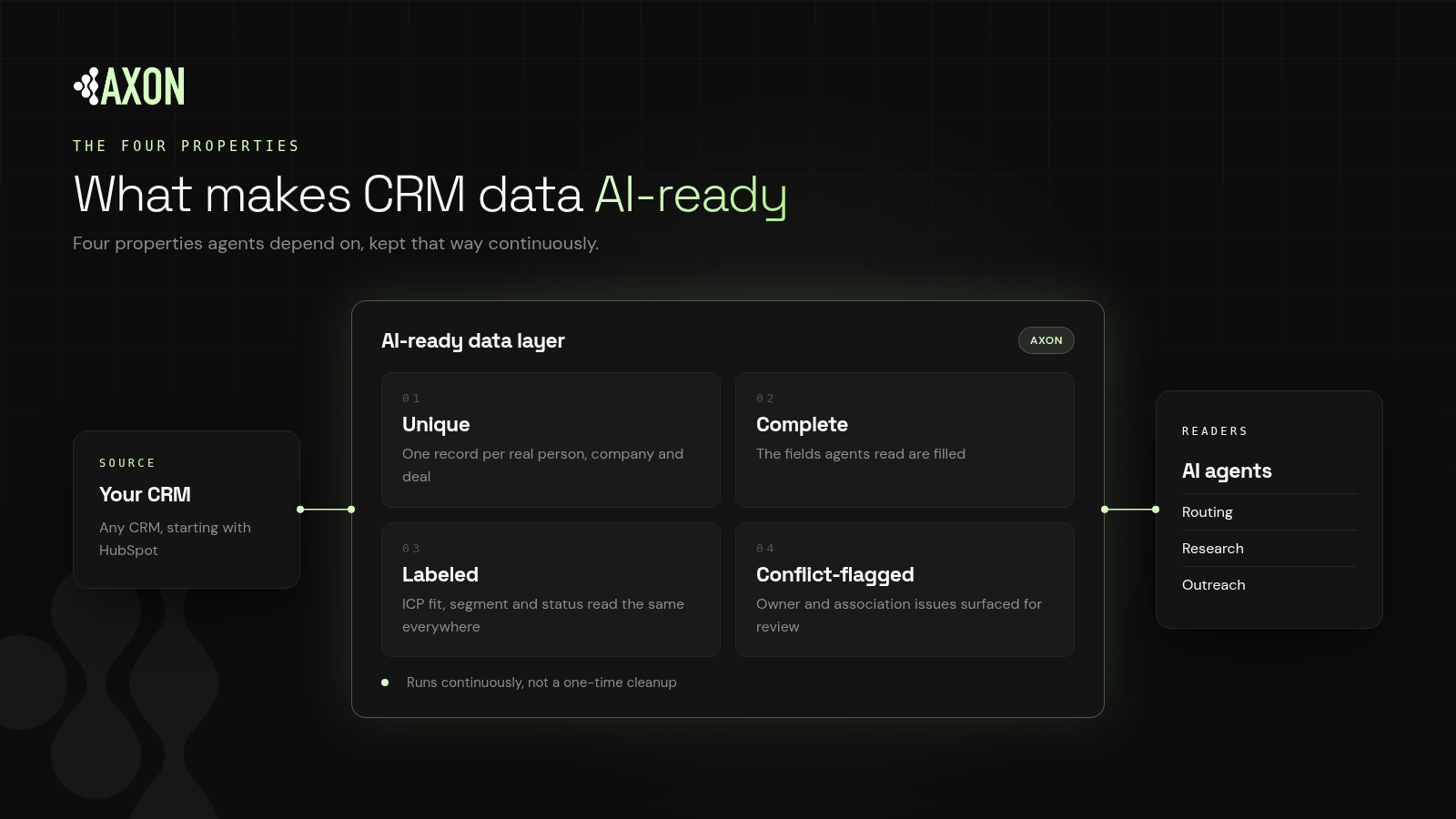
Figure: AI-ready CRM data sits between your CRM and your agents. It is unique, complete, labeled, and conflict-flagged, and it stays that way through continuous monitoring.
Why do AI agents need a different standard of CRM data?
Humans read CRM data with context. They remember last week's call, they know the regional VP changed, and they skim past a blank industry field. Agents do none of that. They take the record at face value and act on it, often at scale and often without a pause.
Here's what that looks like in practice:
- A routing agent assigns a new inbound lead to the owner on a duplicate company record, not the one the account team actually works.
- A research agent writes an account brief using a stale "Customer" status on a record that churned months ago.
- An outreach agent sequences a contact who is already in an open deal, because the contact-to-deal association was never created.
None of these are model failures. The model did exactly what the data told it to do. That's the core idea behind AI-ready data: an agent's output is only as trustworthy as the record it read.
What are the four properties of AI-ready CRM data?
1. Unique: one record per real-world entity
Definition: A CRM is unique when each real person, company, and deal is represented by exactly one record.
Duplicates are the most common reason agents give inconsistent answers (see our guide to HubSpot duplicate cleanup). Two company records split activity history, owners, and deal context in half. An agent that reads one of them sees only part of the picture. AI-ready data means duplicates are found and flagged for review continuously, not just during an annual cleanup.
2. Complete: the fields agents need are filled
Definition: A record is complete when every field that downstream agents depend on contains a valid value.
Completeness doesn't mean every property is populated. It means the fields that drive decisions are: industry, company size, lifecycle stage, country, and whatever else your agents use to qualify, route, or personalize. A blank field forces an agent to guess or skip, and both are bad outcomes.
3. Labeled: every record carries its meaning
Definition: Record labeling is attaching a consistent, machine-readable classification to each record, such as ICP fit, segment, or status, so every agent interprets it the same way.
Labels turn raw fields into decisions an agent can reuse. Instead of every agent re-deriving "is this a good-fit account?" from ten different properties (and sometimes coming to different conclusions), it reads one label. Labels are what make agent behavior consistent across workflows.
4. Conflict-flagged: problems are surfaced before agents act
Definition: A conflict is any disagreement between related records, for example a contact owned by one rep while its company is owned by another, or a deal with no associated company.
Owner mismatches and broken associations (see HubSpot owner conflicts) are some of the hardest issues to spot by hand, and they're exactly where agents go wrong. AI-ready data doesn't mean these conflicts are silently "fixed" by a script. It means they are found, flagged, and routed to a person who can decide what's correct.
What isn't AI-ready CRM data?
It helps to be precise about what this term doesn't mean:
- It isn't a one-time cleanup. CRM data drifts every day as forms, imports, integrations, and reps add records. A database that was clean last quarter isn't AI-ready today unless something has kept it that way.
- It isn't "more data." Enrichment can help fill gaps, but piling more fields onto duplicate or conflicting records just makes the confusion bigger.
- It isn't tied to one model. AI-ready data is model-agnostic. If your data is trustworthy, you can swap the agent or the model underneath without starting over.
- It isn't silent auto-repair. Rewriting owners or associations automatically can break territory rules and erode trust. Changes that need judgment should be flagged for a person to approve.
How do you make CRM data AI-ready?
Step 1: Decide what your agents actually read
List the agents and workflows you run or plan to run, such as routing, research, outreach, and forecasting, and note the fields and associations each one uses. This becomes your definition of "complete."
Step 2: Scan for the four gaps
Measure duplicates, blanks in critical fields, missing or inconsistent labels, and owner and association conflicts. Most teams find the conflicts category is bigger than they expected.
Step 3: Fill and label the safe things automatically
Blank fields and record labels are additive. Writing a value into an empty field or attaching a label doesn't overwrite anyone's work, so it's a safe place for automation.
Step 4: Flag everything that needs judgment
Duplicates, owner conflicts, and broken associations should be surfaced to a person with enough context to decide quickly. That keeps humans in control of the changes that matter.
Step 5: Keep it running
Make the scan continuous. New records should be checked as they arrive, not months later. The agent-ready CRM checklist turns these steps into 12 pass/fail checks.
How does Axon Data keep CRM data AI-ready?
Axon Data is the AI transformation layer for revenue data. It sits between your CRM and the agents that read it, and it works with any CRM, starting with HubSpot. Axon Data runs continuously rather than as a one-time project:
- It finds and flags duplicates, owner conflicts, and broken associations so your team can approve the right fix.
- It only auto-writes blank fields and labels, the additive changes that are safe to automate.
- It serves agents one consistent, labeled view of each record, so every workflow reads the same truth.
The result is a CRM your agents, and the RevOps and sales leaders who depend on them, can trust without checking every answer first.
Want to see where your CRM stands today? Get a free CRM scan from Axon Data.
What else do people ask about AI-ready CRM data?
What does AI-ready CRM data mean?
AI-ready CRM data is revenue data that agents can act on without human double-checking. It's unique (no duplicates), complete in the fields agents use, consistently labeled, and has owner and association conflicts flagged for review.
Why isn't a clean CRM for humans good enough for AI agents?
People fill gaps with memory and context; agents don't. An agent takes each record at face value, so a duplicate, a blank field, or a mismatched owner turns directly into a wrong action, often repeated at scale.
Is AI-ready data a one-time project?
No. CRM data changes every day through forms, imports, integrations, and manual edits. Staying AI-ready requires continuous monitoring so new problems are caught as they appear.
Should owner conflicts and associations be fixed automatically?
Generally not. These changes involve territory rules and team judgment. A safer pattern is to find and flag them so a person can approve the fix, and to reserve automation for additive changes like filling blank fields and adding labels.
Does Axon Data only work with HubSpot?
Axon Data is built to work with any CRM, starting with HubSpot. It runs continuously as a layer between your CRM and your agents.
See where your CRM stands today: duplicates, blank fields, owner conflicts and broken associations.
Get a free CRM scan