Clay Alternative for CRM Cleanup: Clay Enriches, Axon Data Keeps the CRM Trustworthy
Looking for a Clay alternative for CRM cleanup is often the wrong frame: Clay enriches records, while cleanup keeps the CRM itself trustworthy. Axon Data labels records and finds and flags duplicates, owner conflicts and broken associations. For most sales-led HubSpot teams, it complements Clay rather than replacing it.
People often search for a "Clay alternative" when what they actually need is a different tool for a different problem. This post explains the difference so you can pick the right one, or run both.
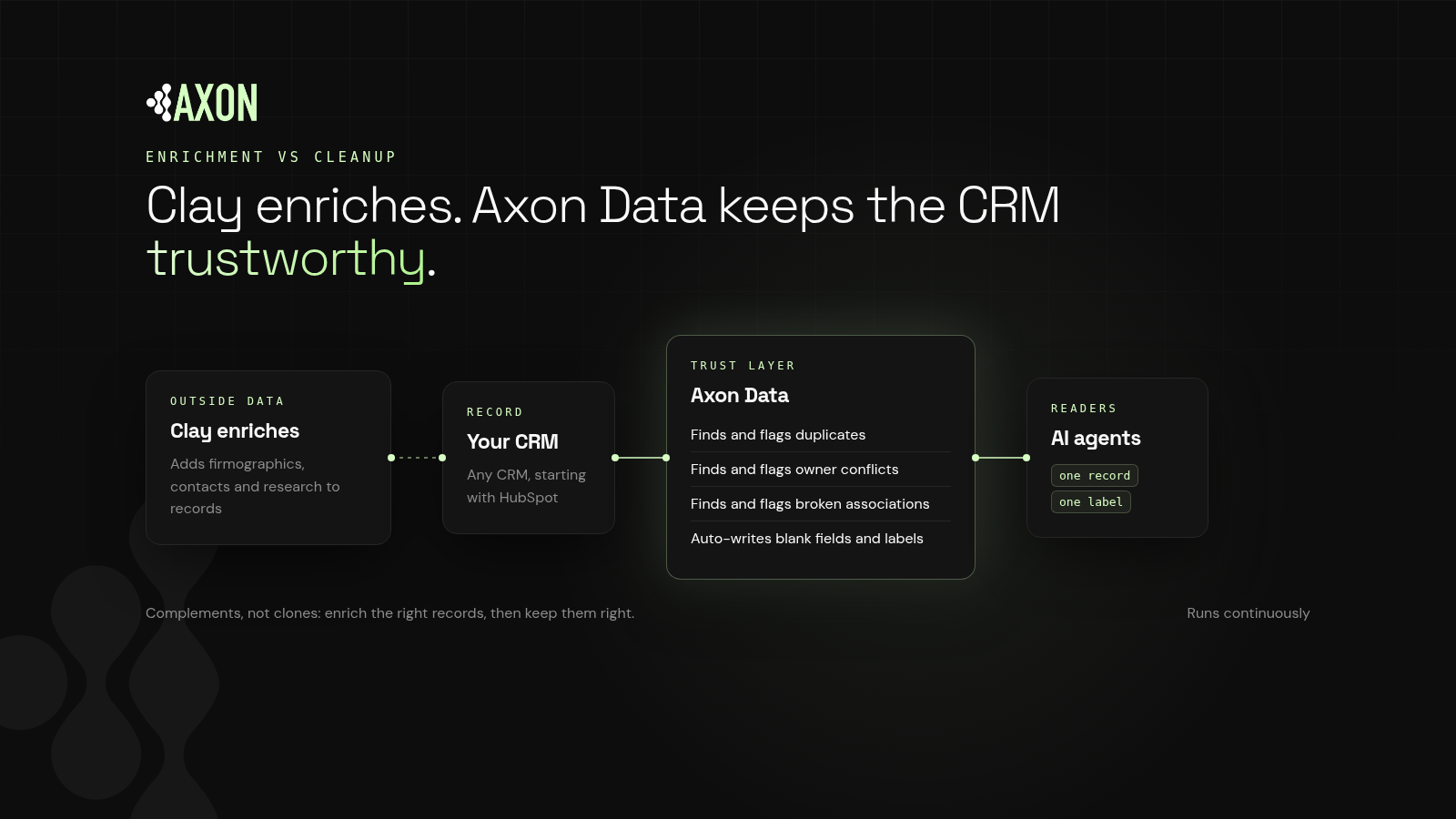
Figure: Clay brings outside data in. Axon Data sits between the CRM and its readers, keeping records unique, labeled and conflict-flagged so agents act on one trustworthy record.
What is Clay built for?
Clay describes itself as infrastructure to get data, run agentic workflows and launch go-to-market plays. Based on Clay's own site and documentation as of October 2026:
- A data marketplace. Clay offers one contract for data from 200+ data and AI providers, with firmographic, technographic, contact and intent data.
- Waterfall enrichment. Clay can try several providers in sequence until it finds a value, which raises coverage on fields like email and phone.
- Claygent. Clay's AI web research agent finds information that isn't in standard databases.
- CRM sync. Clay can import records from HubSpot or Salesforce into a table, enrich them, and write results back. Its CRM enrichment use case is about keeping records complete and refreshed.
- Plays. Clay supports lead scoring, inbound routing, outbound personalization and ad audiences.
That's a broad, capable toolkit. If your problem is "we don't know enough about these accounts," Clay is a strong choice.
Definition: Enrichment is adding new information to a record from outside sources, such as company size, industry, technographics or a verified email.
Is CRM enrichment the same as CRM cleanup?
Cleanup is about the records you already have and how they relate to each other.
Definition: CRM cleanup is making sure each real-world entity appears once, related records agree with each other, and the fields and labels downstream readers depend on are filled and consistent.
Enrichment can fill a blank industry field. It can't decide on its own which of two "Acme" company records is the real one, or whether a contact should belong to the rep who owns its company. Those are judgment calls inside the CRM.
Here's where the two jobs separate:
| Problem | Enrichment helps? | What it actually needs |
|---|---|---|
| Blank industry or company size | Yes | A trusted value written into the empty field |
| Two records for the same company | Not by itself | Duplicate detection and a person to approve the merge |
| Contact owner differs from company owner | No | A conflict check and an approved owner |
| Deal with no associated company | No | An association check and a reviewed fix |
| Inconsistent "is this a customer?" logic | Partly | One shared label every agent reads |
Enriching records that are duplicated or conflicting can make the confusion bigger: two "Acme" records now each have full firmographics, and an agent has even more reason to treat them as separate accounts.
What does Axon Data do instead?
Axon Data is the AI transformation layer for revenue data. It works with any CRM, starting with HubSpot, and runs continuously, never as a one-time cleanup.
Finds and flags the judgment calls
Axon Data finds and flags duplicates, owner conflicts and broken associations, and suggests a fix. Your admin reviews and approves, one record or many at once.
Auto-writes only what's safe
Axon Data only auto-writes blank fields and labels (see filling blank fields in HubSpot). Filling an empty field or adding a label doesn't overwrite anyone's work, so it's a safe place for automation.
Labels every record
Each record carries a consistent label, such as ICP fit, segment or status. That's what makes CRM data AI-ready. Agents read the label instead of re-deriving it from raw properties, so routing, research and outreach agents all reach the same answer.
How do Clay and Axon Data work together?
The two tools fit together in a simple order:
1. Keep the base trustworthy
Axon Data flags duplicates and conflicts so you know which record is the real one before anything else writes to it.
2. Enrich the right records
Clay enriches the records that matter. When enrichment syncs back, match updates on the HubSpot record ID and avoid overwriting good values with blanks. Both safeguards work best on a deduplicated base (see HubSpot duplicate cleanup).
3. Label and monitor
Axon Data labels enriched records and keeps watching for new duplicates, blanks and conflicts as forms, imports and integrations add data.
4. Agents read one record
Your agents read one consistent, labeled record instead of reconciling raw fields from multiple sources.
When do you actually need a Clay alternative?
If you're looking to replace Clay's enrichment itself, compare enrichment providers and data platforms on coverage, accuracy and workflow fit. Axon Data isn't that category. Choose Axon Data when the problem is trust in the CRM itself:
- Agents give different answers about the same account.
- Inbound leads are routed to the wrong account executive.
- Reps don't trust pipeline reports because of duplicate companies and deals.
- You're about to add more agents and want the base right first.
How do you choose between enrichment and cleanup?
- Name the problem. Missing information points to enrichment. Conflicting or duplicated information points to cleanup.
- Scan your CRM. Count duplicates, owner conflicts, broken associations and blank critical fields. A free CRM scan from Axon Data does this on your own data.
- Fix order matters. Flag and resolve duplicates before large enrichment runs.
- Decide what writes automatically. Keep automatic writes to additive changes and route the rest to a person.
What else do people ask about Clay alternatives for CRM cleanup?
Is Axon Data a Clay alternative?
For enrichment, no. Clay is built to find and add outside data. Axon Data keeps the CRM trustworthy by labeling records and finding and flagging duplicates, owner conflicts and broken associations. Many teams use both.
Can Clay clean CRM data?
Clay can fill and refresh fields through enrichment and write them back to HubSpot or Salesforce. Resolving duplicates, owner conflicts and broken associations inside the CRM is a separate job that needs detection and human review.
Should I deduplicate before enriching?
Generally, yes. Enriching duplicates fills out multiple versions of the same company or contact. Flag and resolve duplicates first, then enrich the surviving records.
Does Axon Data overwrite data that Clay writes?
No. Axon Data only auto-writes blank fields and labels. Changes to duplicates, owners and associations are flagged for your admin to approve.
Which CRMs does Axon Data work with?
Axon Data works with any CRM, starting with HubSpot.
See where your CRM stands today: duplicates, blank fields, owner conflicts and broken associations.
Get a free CRM scan